

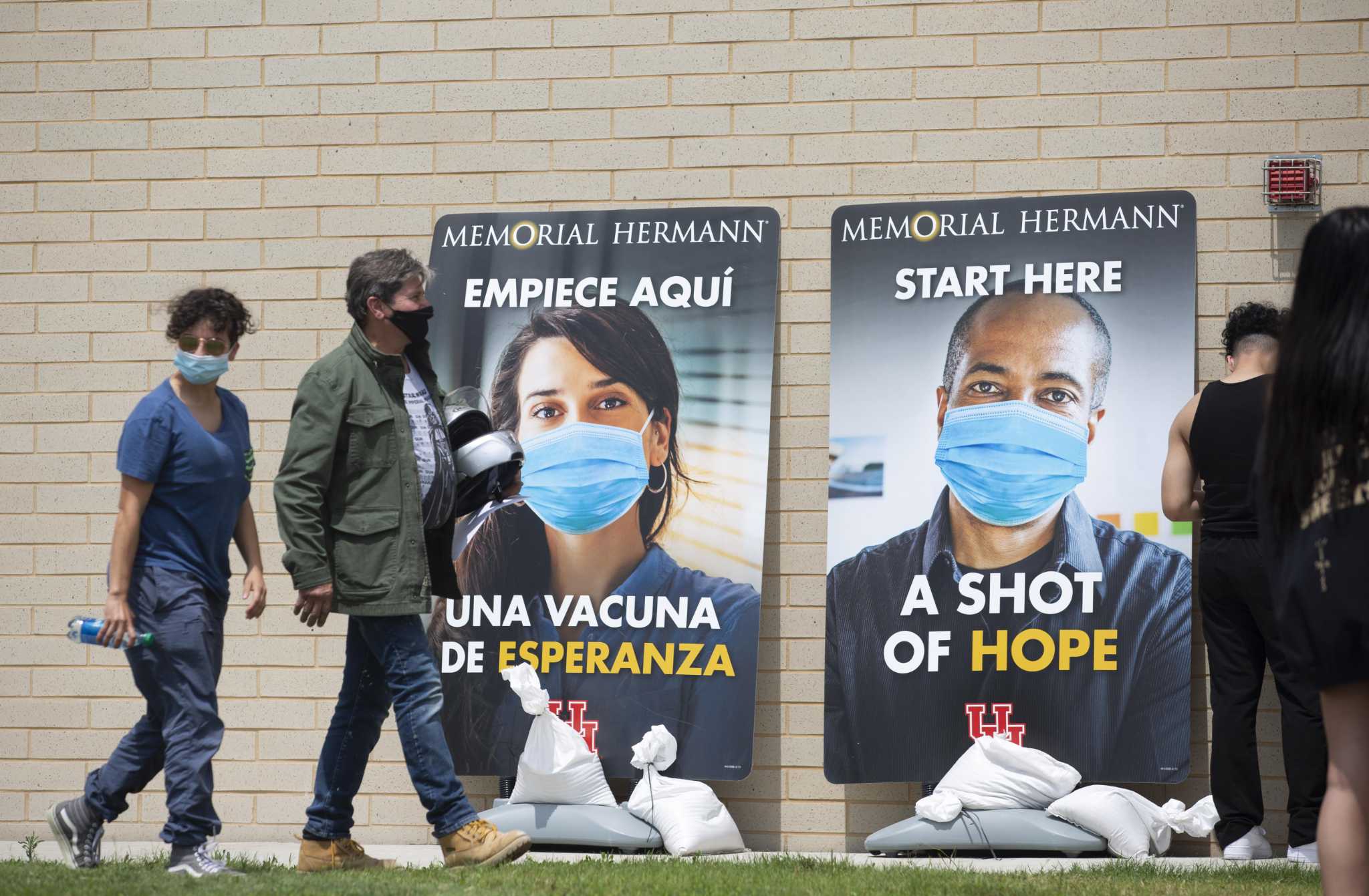

Chronicle reporters ask themselves questions about COVID-19, safety precautions, and vaccines every week. In this week’s COVID Helpdesk, we are looking at odor recovery in long-distance COVID patients, breakthrough infections, whether the vaccine will reduce the number of severe COVID cases and hospital stays, and the lambda variant.
For many people who contracted the virus, a loss of smell or a change in smell was one of the first symptoms.
Dr. Tran Locke, assistant professor of ENT medicine at Baylor College of Medicine, said there is still no clear answer on whether all COVID survivors or long-distance drivers will regain their sense of smell.
Locke sees at least two patients a week who have had odor loss due to COVID-19. In some patients the odor has completely returned; others say they often smell something rancid. A subset of their patients can detect smells like vanilla, but it’s not what it was before.
In other patients who experience loss of smell, either from brain injury or a non-COVID viral infection, Locke said that what they can smell a year after the infection is usually their new normal.
COVID survivors can also experience parosmia, an odor distortion when that odor is present, Locke said. “Some people say oranges or coffee can smell or taste like rotten meat or dirty socks,” she said. “This can take months, and the thinking process is that the olfactory nerve is recovering and sometimes rewired, making the wrong connection in the brain that distorts the smell.”
However, patients reporting rancid odors had better results on spontaneous odor recovery, Locke said.
Some Houston COVID survivors have started odor training that includes essential oils like lemon, eucalyptus, clove and rose in their daily odor routine, she said. With odor therapy, more than 90 percent of patients who experienced loss of smell for non-COVID reasons have regained that feeling after six months – although it may have been different than before, she said.
“People take smells and tastes for granted until it’s gone,” said Locke. “For safety reasons, being unable to smell is dangerous, and long-term loss can lead to depression. It seems small, but it has a big impact. “
What is a breakthrough infection?
Breakthrough infections occur when a person becomes infected with a virus or disease two weeks or more after being fully immunized, said Katelyn Jetelina, an epidemiologist at the UTHealth School of Public Health in Dallas.
“It can happen with any vaccine,” said Jetelina. “The effectiveness of our vaccines is astonishingly high, but not 100 percent. Unfortunately, we expect breakthroughs. “
The Centers for Disease Control and Prevention reported that by July 6, more than 157 million Americans had been fully vaccinated. In Texas, 12.3 million are fully vaccinated.
Asymptomatic infections will occur in people who have been vaccinated, and there is evidence that vaccination makes illness less serious in those who have symptoms, the CDC reported. Between January 1 and April 30, the CDC reported that of 3,880 breakthrough infections, 2,725 people were asymptomatic, 995 were known to have been hospitalized (but it’s unclear whether it was COVID or some other medical problem), and 160 people died.
Vaccines protect most people from severe cases that result in hospitalization or death, Jetelina said.
However, the less effective the vaccine is, the more likely the person could have a breakthrough infection, she added, which explains why people who received a vaccine in another country with a lower rate of effectiveness might be more susceptible to a breakthrough infection with COVID. But that doesn’t automatically mean it’s a serious infection.
“By far the best protection is the vaccine,” said Jetelina. “If you come into contact with an unvaccinated person who carries the disease, there is a small risk that you will get it. It’s a small risk, but the risk is still there. “
There’s no harm in wearing protective layers like a face mask, especially if you’re indoors or in a tight space with people who aren’t in your household, she added.
Since vaccines are widespread, how severe are positive COVID cases leading to hospitalization?
COVID hospital stays at two Houston hospitals have doubled in the past two weeks, and health officials attribute this to an increase in Delta variant cases.
Houston Methodist sequences for specific variants, and models estimate that the Delta variant will account for 92 percent of all new infections in the coming weeks. According to spokeswoman Lisa Merkl, more than 40 percent of new COVID hospital admissions since mid-June are Delta cases.
Dr. David Callender, President and CEO of Memorial Hermann, said the system is seeing the effects the fast-paced variant because of a dramatic increase in positive cases going to the emergency rooms. But he said they don’t test for certain variants because the treatment is the same.
Of 55 positive cases identified in Memorial Hermann’s emergency rooms on Monday, 35 were sent home for isolation and 20 were hospitalized because their symptoms were severe enough to warrant it, Callender said.
Callender said the vaccines “hold safe,” which means few of the new hospital patients are vaccinated. “By and large, the people we see aren’t vaccinated,” he said.
Do we have to worry about the lambda variant?
The CDC routinely monitors viral mutations and variants by sequencing positive COVID-19 tests and then classifying them as variant of interest, variant of concern, and variant of high consequence.
Interesting variants are more transmissible than the original strain, have caused outbreaks in multiple countries, and could cause more serious illness, but have limited prevalence in the United States and other countries, according to the World Health Organization.
Variants of concern show evidence of increased communicability, more severe disease, a significant decrease in neutralization by antibodies produced during previous infection or vaccination, and decreased effectiveness of treatments or vaccines. On Tuesday, questionable US variants were listed as B.1.1.7 (Alpha), B.1.351 (Beta), B.1.617.2 (Delta) and P.1 (Gamma).
C.37 or the lambda variant is listed as an interesting variant in the USA, although it is spreading rapidly in South America. The earliest cases were found in Peru in December, and according to the country’s health ministry, lambda now accounts for 90 percent of Peruvian infections.
Researchers will continue to monitor the spread of lambda due to a certain mutation in its spike protein that can make the virus more infectious, said Dr. Pei-Yong Shi, Professor of Biochemistry and Molecular Biology at the UTMB.
The mutated virus shows little improvement when treated with monoclonal antibodies through convalescent plasma therapy, Shi said.
“Once you have this mutation, it confers resistance to several monoclonal antibodies, including those approved by the FDA for treating coronavirus symptoms,” Shi said. “It’s something that needs to be closely monitored, but I don’t know it’s more transmissible (than the original virus).”
CDC data suggests vaccines approved for use in the United States – Pfizer, Moderna, and Johnson & Johnson – protect against most of the variants currently circulating in the country. According to National Geographic, the variety has so far been detected in 29 countries.
“However, variants will cause some breakthrough vaccine cases,” the CDC reported.
julie.garcia@chron.com
Twitter.com/reporterjulie
[ad_1]
