

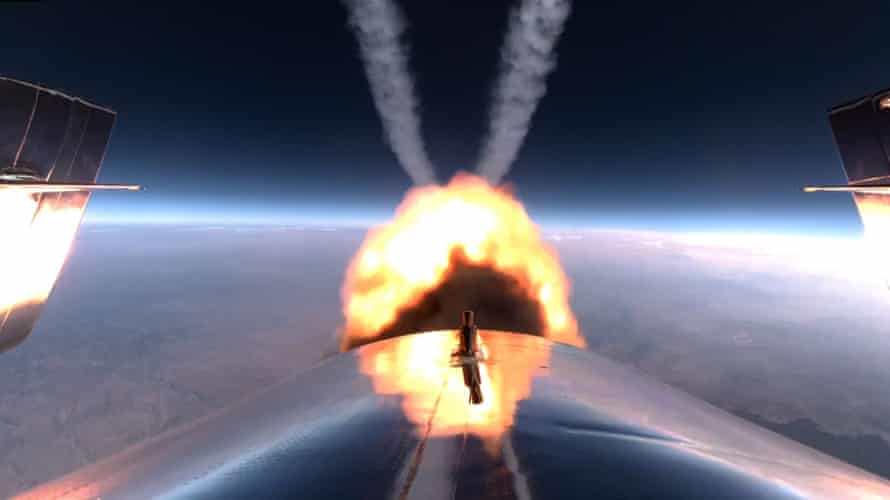

Last week, Virgin Galactic took Richard Branson off the edge of space about 53 miles (86 km) – part of a new space race with Amazon billionaire Jeff Bezos, who plans to undertake a similar journey on Tuesday.
Both very wealthy business people hope to massively increase the number of people in space. “We’re here to make space more accessible to all,” Branson said shortly after his flight. “Welcome to the beginning of a new space age.”
People are already buying tickets to space. Companies like SpaceX, Virgin Galactic and Space Adventures want to spread space tourism.
The Japanese billionaire Yusaku Maezawa spent an undisclosed sum of money on SpaceX in 2018 for a possible future private orbit around the moon and back. And this June, an anonymous space lover paid $ 28 million to fly Bezos on Blue Origins New Shepard – although he was later withdrawn due to a “planning conflict”.
But this launch of a new private space industry that cultivates tourism and human exploitation could come with huge environmental costs, says Eloise Marais, associate professor of physical geography at University College London. Marais studies the effects of fuels and industries on the atmosphere.
When rockets go into space, they need a huge amount of fuel to get out of the earth’s atmosphere. For SpaceX’s Falcon 9 rocket it is kerosene and for NASA it is liquid hydrogen in their new space launch system. These fuels emit a variety of substances into the atmosphere, including carbon dioxide, water, chlorine, and other chemicals.
The CO2 emissions from rockets are low compared to the aircraft industry, she says. But they’re rising nearly 5.6% a year, and Marais has been running a simulation for a decade to see at what point they’ll compete with the traditional sources we know.
Richard Branson’s Unity 22 rocket motor burns on its way into space. Photo: Virgin Galactic / Zuma Wire / Rex / Shutterstock
“For a long-haul flight it is one to three tons of carbon dioxide [per passenger]“Says Marais. For a rocket launch, it is 200-300 tons of carbon dioxide, which carries around four passengers – almost two orders of magnitude more, according to Marais. “So it doesn’t have to grow so much to compete with other sources.”
The number of rocket flights is currently very low: According to NASA, there were 114 attempts at orbital launch in the world throughout 2020. That compares to the aviation industry’s average of more than 100,000 flights per day.
But missile emissions are emitted into the upper atmosphere, which means they stay there for a long time: two to three years. Even water injected into the upper atmosphere – where it can form clouds – can have warming effects, says Marais. “Even something as harmless as water can make a difference.”
Closer to the ground, all fuels emit large amounts of heat that can add ozone to the troposphere, where it acts like a greenhouse gas, storing heat. In addition to carbon dioxide, fuels such as kerosene and methane also produce soot. And in the upper atmosphere, the combination of elements from the burning of fuels can destroy the ozone layer.
“While there are a number of environmental impacts from spacecraft launch, the depletion of stratospheric ozone is the best studied and the most directly worrying,” wrote Jessica Dallas, a senior policy advisor for the New Zealand Space Agency, in an analysis released last year Research results on emissions from space launches.
Another 2019 report from the Center for Space Policy and Strategy compared the problem of space emissions to that of space debris, which the authors say poses an existential risk to the industry. “Today, launch vehicle emissions are a distinctive echo of the space debris problem. The rocket engine exhaust gases emitted into the stratosphere as they go into orbit are detrimental to the global atmosphere,” they wrote.
“We just don’t know how big space tourism could get,” says Marais.
A new market report estimates that the global suborbital transportation and space tourism market is valued at $ 2.58 billion in 2031 and will grow by 17.15% every year for the next decade.
“The main driving force behind the resilience of the market will be focused efforts to enable space transportation, emerging startups in suborbital transportation and increasing developments in low cost launch sites,” the report said.
In the past, most space transportation has focused on cargo delivery missions to the International Space Station and satellite launch services, but currently that focus has shifted to space transportation, planetary exploration, manned missions, suborbital transportation and space tourism.
Several companies, including SpaceX, Blue Origin, and Virgin Galactic, have focused on developing platforms such as rocket-powered suborbital vehicles that enable the industry to conduct suborbital transportation and space tourism.
People have suggested that the money these billionaires put into space technology could be invested to improve life on our planet, where forest fires, heat waves, and other climate catastrophes are becoming more common while the globe is in climate crisis warmed up.
“Is anyone concerned that billionaires are running their own private space race while record-breaking heat waves ignite a ‘fire-breathing cloud dragon’ and boil sea creatures to death in their clams?” Tweeted former US Secretary of Labor Robert Reich last week.
Marais says that new developments in space always bring some excitement – but it’s still possible to take responsibility while doing something exciting at the same time. She urged caution as the space tourism industry grows and says there are currently no international rules governing the types of fuels used and their impact on the environment. “We don’t currently have any rules on missile emissions,” she says. “The time to act is now – while the billionaires are still buying their tickets.”
[ad_1]
